Thursday, 24 March 2011

About those Lambert / Viscount Death Forks


The amount I have written on this blog so far without mentioning ‘death fork’ and Viscount or Lambert in the same sentence is probably a record.  Now I will say a bit about it.  Despite dire warnings about ‘death forks’ on the Internet, there are very few facts to back them up.  

To begin at the beginning, even the earliest Lamberts (like my 1972 gold plated Professional Grand Prix) had a cast aluminium alloy front fork (the part that holds the front wheel).  As with most traditionally constructed bikes, this was attached to a steel ‘steerer’ - the part that turns in the headset bearings and into which the stem holding the handlebars fits.  In the early 1970s aluminium forks were extremely innovative if not unique.  The idea was (of course) to reduce the weight of the bike.  Incidentally the feel of the bike was changed, because aluminium behaves differently to steel under stress.  (The modulus of elasticity is different.)  Some people don’t like the ‘feel’ of ally forks.

Unfortunately, there were accidents resulting from sudden catastrophic failure of Lambert forks.  If you are travelling at any speed, the failure of anything at the front of the bike - fork, wheel, stem or bars - is frightening and potentially very serious.  I know of a friend of a friend who experienced Lambert fork failure and was scarred as a result.  So I don’t doubt the reality of an ‘injury fork’; even if no-one was killed.  The number of forks that broke has been reported as less than 1% of the 30,000 or so bikes made with the ‘death forks’.  Unacceptable, but not as bad as some would have you believe.
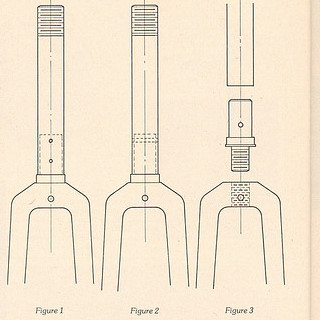
Failure seems to have been associated with the method of attaching the fork to the steerer.  The first picture shows this.  The crown of the forks had an integral extension that fitted into the steel steerer tube.  To make this joint as firm as possible, the steerer tube was heated, making it expand, before fitting it over the crown extension.  When it cooled, it contracted and gripped the alloy part firmly. A couple of dowel pins (probably spiral pins like these) were inserted in holes running front to back.  This is the first version of the alloy fork.  The second version was similar but had the pin put through from side-to-side.  This might have been an attempt to reduce stress concentration in the part.  However, both these versions were known to fail, usually as the result of an impact of the front wheel with a kerb or other immovable object.  Breakage occurred near the base of the fork extension.  The article accompanying these diagrams calls these two types the Lambert forks and the third version the Viscount one.  The article is by Yamaha so this may just be a device to distance Viscount from the Lambert failures.  My other Lambert bike has a type three fork, although a replacement - perhaps a partial product recall - cannot be ruled out.
The third version of the forks, presumably introduced because of continuing failures of the earlier versions, brought in a separate steel crown extension.  This screws into the crown of the forks and is secured with Loctite™.  The mounting bolt for the front brake passes through the whole assembly and gives further security.  The upper part of the steel insert fits into the steerer and is secured with a pin.  Information on the Internet is that the third type is very reliable.  They are still found on Viscounts that come up for sale, (they were only fitted to the top of the range Aerospace Pro), which have notched up considerable mileages. They were used on the works team bikes in road racing and by others for cyclocross.  See this Cycling Touring Club (CTC) forum for more details.  Nevertheless, at some point in the late seventies, the new owners of the marque, Yamaha, decided to mount a full-scale product recall of all alloy forks and free replacement with steel (Tange?) ones.  I think this must have been a response to continuing bad publicity / bad mouthing about the Lambert forks and the difficulty of telling one type from the other.  It is clear that Lambert did not handle the fork problem well and, despite the efforts of Trusty/Viscount to sort out this and the early quality problems, its shadow was still hanging over the bike into Yamaha times.

It is actually quite easy to tell if your bike has a third version fork or one of the earlier ones.  First check with a magnet or by inspection that you have alloy (non-magnetic) rather than steel forks.  If the latter, you need worry no further.  Most Viscount steel forks have traditional square shoulders with lugs.  Some have sloping shoulders and look superficially like the alloy forks.  Alloy forks were always supplied unpainted; steel ones were painted and often (depending on the model) half chromed.

To check alloy forks, remove the front wheel and the front mudguard (fender) if fitted.  Ideally, turn the bike over to get a good look.  If the underside of the fork crown - i.e. between the ‘legs’ - is smooth alloy; then you have an early version.  I would not suggest that anyone rides a bike with one of these, other than for a sedate Sunday afternoon turn around the park.  If you can see a circular indentation in the centre of this part of the forks that you can’t clean away (!), test it with a small magnet, such as a round fridge magnet.  You should be able to detect that in the centre there is a magnetic steel part, whereas the rest of the fork is non-magnetic.  I am quite happy to ride a bike with an alloy fork of the third kind on a daily basis, as I might with any other twenty-five year old component, but I cannot advise readers what to do.

Finally, in case people think that Lambert and Viscount are the only bikes that have ever had problems, see this recall notice for forks used on a Cervelo bike.  As it says ‘The forks steerer can break during normal use.  In some circumstances this can cause the rider to lose control, fall and suffer serious injuries’.  Might have been written about the Lambert ‘death fork’.

Thanks to the careful reader who pointed out that the Trusty factory was in Bilston, a former steel-making town about 4 miles south-east of Wolverhampton, not in Birmingham as I said.  At least I got the region right (West Midlands).

Friday, 11 March 2011

Design Magazine May 1976 - details of Viscount bike

A friend (thanks Steve) has pointed out to me an interesting article on Picasa, reproducing part of the May 1976 Design Magazine.  This has an ad. showing a Viscount Aerospace Pro (GB£115 - about US$188 at today's rate of exchange).  It mentions the Aerospace range starting with a bike for just under GB£80 (US$131).  What model would that have been?  Sounds like incredibly good value, even in 1976.  At this time the Viscount brand was being produced by 'Viscount-Trusty Ltd.' of Potters Bar, Hertfordshire, UK.  (Potters Bar is on the outskirts of London.)

Also from the magazine is a one page article on the Viscount Aerospace bikes that has interesting photographs of a Viscount bottom bracket, pedal and hub that have been sectionalized to show how they were made.  The article quotes Cycling magazine as saying that the Aerospace Pro could be used for 'road-racing, time trialling, cyclo-cross, training and touring'.  It also mentions a competition model made by Trusty, 'slightly lighter' but twice the price.  Does anyone know what bike that was?   Any pictures or descriptions?

Many thanks to 'ichibyoshi', who posted this very interesting document.  His (could be 'her' I know) other pictures and name suggest a home in Japan.   My thoughts are with you and other citizens of Japan and countries of the Pacific whose lives, homes and livelihoods are threatened by the earthquake and tsunami that happened today.

Friday, 4 February 2011

Replacing Viscount bottom bracket bearings

Over last weekend I dismantled the bottom bracket on my 1978 Viscount Aerospace bike and replaced the bearings.  This turned out to be quite straightforward - surprising considering all that has been written about these components, but it is fair to say that, according to a friend with more experience of Viscount bottom brackets, I was lucky with this one.  It wasn’t too stuck and not rusty.

First I took off the cranks.  The spindle wobbled in one of the bearings, showing that replacement was overdue.  It was then necessary to remove the circlips, in theory there to stop the spindle sliding through the bearings but probably not doing anything.  A proper pair of circlip pliers helps, but you can improvise with little screwdrivers or some such.  

To remove the spindle I sized up various tools but picked up a hefty hammer.  I tried putting a bit of wood between the hammer and the end of the spindle, but that didn’t work so I just bashed away.  Should anyone be following this, put the crank screw in the spindle and hit that.  It saves distorting the end of the spindle. However, it might damage the screw, although I was lucky.  I had to file the spindle back into shape.  It slid quite easily out of the bearings although one of them fell apart.  Getting the bearings out required a narrow cold chisel (a six-inch nail might have worked) and the hammer.  There are ‘pullers’ for extracting bearings.  I have one, but the hammer method is fine when the bearings are shot anyway.  The pictures show the shell and the spindle together with an old bearing and a new one (the new one on the left) and the circlips.


I cleaned up the spindle and the seats for the bearings carefully.  I was advised to ‘polish’ the spindle (thanks Steve) and I did that.  I put one bearing on to the spindle, using an old adjustable spanner to convey the taps of my hammer to the inner ring of the bearing.  I thought whether I should put Loctite or anti-seize compound on the spindle and bearing housings and went for the anti-seize, thinking that nothing was likely to move once assembled.  Then I just needed to tap the bearings in, opening up the adjustable spanner to strike their outer rings until they were flush with the shell.  Here’s a picture of this.


After adjusting the position of the spindle and fitting the circlips, the job was done.  The cranks went on nice and square and the result is great - sm-o-o-o-th.

If your bb spindle is damaged or lost there are replacements around.  The length is 122mm or 123mm, depending on who you read.  To my shame, I forgot to measure mine.  Anything from 120 - 123mm would probably work as well.  Phil Wood at one time made a stainless steel spindle that would be bomb-proof.  This one on eBay would probably be ok.  YST made a similar spindle.  There are other options for replacing Viscount bottom brackets, which I will describe another day.

The bearings are numbered ‘6003’, measuring 35mm outside diameter x 17mm inside diameter x 10mm thick.  The ‘6’ gives the type of bearing (single row deep groove) and shows it is a metric size.  The first zero is the series, which indicates the thickness and outside diameter.  The ‘03’ at the end shows that the bore is 17mm.  I found this out from the Gizmology site.  If you are buying bearings for your Viscount or Lambert, you will want 6003-2RS ones.  The 2RS means that both sides have rubbers seals to keep out dirt and grit.

Sunday, 30 January 2011

Bottom brackets

On Friday morning I noticed that the bottom bracket spindle on my 1978 Viscount Aerospace Pro seemed to be running loose in its bearings.  This caused the chain wheel to wobble and my gear changes to be a bit hit-or-miss.  It also prompts me to talk about the bottom brackets used in Lambert and Viscount bikes.

[Note for people who do not speak ‘bike’:  The bottom bracket is the bit at the bottom (!)  where the pedals go round and round.   The spindle (or bottom bracket spindle) is the bit that is attached to the cranks and the chain wheel.   (It is a spindle, rather than an axle, because it rotates.  Strictly speaking axles don’t turn.)  The bearings are what the spindle turns in.  Traditionally, the bearings were made up of separate bearing ‘cups’ and loose balls.   Together the spindle and bearings make up the ‘bottom bracket’.  The part of the frame in which the bottom bracket fits is the bottom bracket shell.  Nowadays, most bottom brackets are sealed units.]

Lambert was an early adopter of ‘sealed’ bearing units - in fact industry standard ball bearings.  These push fit into the bottom bracket shell and the spindle fits into the bearings.  Circlips were fitted to the spindle to stop any tendency to move from side-to-side.  A similar arrangement was used on Klein bikes.  Here are some photographs and text about changing Klein BBs, which might be of use if anyone is changing a Lambert or Viscount one.

Certain problems arose with the Lambert BBs.  Early spindles and crank sets had parallel-sided square ends, unlike the square tapers then usual for cotterless crank sets.  This was asking for trouble and the cranks were inclined to work loose as the holes in them became enlarged.  Later versions had the normal tapered ends, but there was always a question mark over the accuracy of the machining and the Lambert/Viscount cranks require careful alignment.  Another problem that has been reported is early failure of the spindle, which has been attributed to stress-concentration due to the grooves for the circlips, but might be due to poor castings.  If this happened when you were cycling fast or going uphill it would certainly be frightening, possibly dangerous.  There is a good photograph of Viscount BB spindle failure here and also a way of curing the problem.

Another point is that normal cartridge bearings are not totally ‘sealed’ and they are vulnerable to road dirt getting in and wearing them out.   This is probably what has happened to mine.

Next time I’ll write about the options for your Lambert or Viscount bottom bracket, should you need to replace it, and I hope I will have sorted out mine.

Monday, 24 January 2011

History Part 2

In the mid seventies, probably in 1975, perhaps in 1974, definitely by 1976, the production of Lambert bicycles was taken over by an old established English bike manufacturer by the name of Trusty.  Jigs for the fillet brazed frames were transferred and the stocks of Lambert branded and special components.  The bicycles were now made in Birmingham, England and were called Viscount Aerospace bicycles.  Decals / stickers on the down tubes noted that the frames were made by Trusty.

The first Viscounts, as might be expected, were very similar to the Lamberts but, over the next few years, they evolved into rather different bikes.  Keeping to the same Aerospace fillet brazed frames they sported more modern paint schemes and over time most of the specially-made components disappeared in favour of bits from Shimano and other component makers.

Building on the experience of Trusty, lower-range bike were also badged as Viscounts.  The chronology of this is unclear, but I think that they came in before the company was taken over again, this time by Yamaha, probably in 1978.  They included ones with lugged frames that were built in the UK and ones using Taiwanese-made lugged frames.  Of the first type were the Sebring 10-speed model, which seems to have been a very popular entry-level ‘racing’ bike and one that many people remember with affection.  It began the use of US cities as the model names of Viscount bikes.  I had a Tulsa G.L., which had a made-in-Taiwan frame.  A collection of details of all these models needs to be made.

In 1980 or ‘81 Yamaha-Viscount stopped using the fillet-brazed frame.  The top-of-the range bikes still used the same tubing (or appeared to) and were called Aerospace but the frame was built with rather natty pointed lugs with windows (Prugnat?).  Production had at some point moved from Birmingham to Potters Bar, North London (Hertfordshire), where Trusty had a plant.  By 1980 use of special, own branded components had entirely ceased.  


I have a 1981 catalogue in which the top of the range is one with a Shimano Dura Ace group set.  I’ve never seen one of these.  Second was probably the Viscount Aerospace 600ax, with the Shimano 600ax gruppo.  Just below that must have been the 600ex (you can guess what that came with).  I have one of these and gorgeous it is too.  


Then there were a number of variations around the Viscount Aerospace 400 theme.  It may be that they were intended to use the Shimano 400 components, but my 400 came with a 600 rear derailleur, Dura Ace front mech, Weinmann brakes and SR chainset.  Incidentally Zeus Olimpic 64 pedals were used on lots of Viscount Aerospace bikes, irrespective of the other bits used.  But I am digressing into components.

Despite successes in various races and being named as bicycle of the year in 1980, the marque seems to have disappeared completely by 1982 or 1983.


There is a group on Flickr for photographs of Lambert, Viscount and Trusty bikes.

Saturday, 22 January 2011

History Part 1

Although there are several sources on the Internet, the hisory of Lambert and Viscount bikes is anything but clear. A friend of mine is piecing together information from original sources - people who made the bikes, road on the works teams, dealers and early buyers. If you have any facts about the history of the marque, I would be glad to relay them. See some comments on the CTC forum here. It seems that Lambert bikes was a project to produce high quality lightweight bikes much cheaper than those offered by established builders. It was apparently headed by the son of the founder of the Marriot hotel chain, but manufactured its bikes in England. It may have been associated with a revival of the Viking name, the original company having closed in 1967, since some early Lamberts were badged as Vikings. See the Classic Rendezvous site. The first Lamberts seem to have appeared in 1972, using a rather nice lugged frame. Here are some photographs of a frame of one of these I own. It is a gold plated Professional Grand Prix.


An important aspect of the bikes was the use of 'aerospace' tubing for the frame. This is a chromium-molybdenum (cro-moly) steel alloy but not one produced by an established bicycle tube manufacturer like Reynolds or Columbus. It seems to have come from a British company called Phoenix. Although straight gauge (not butted) it produced light frames and was used for the top-of-the range Viscount bikes until the end of that company. Lambert frames carried stickers extolling the virtues of the tubing. Also very obvious on the Lambert bikes was the extensive use of alloy components specially made for the bike, rather than bits from the established component manufacturers. Various theories have been advanced for this and the unusual steel used for the frame. These include: the design team was made up of cycling enthusiasts, determined to produce their ideal bike; there were lots were ex-aircraft engineers in the company, perhaps from cancelled UK projects like the BAC TSR2 bomber (stopped in 1965); and (!) they were all crooks. I think the last can be safely discounted. The components are so interesting that I will blog about them separately. At some point production changed over to a fillet brazed (lugless) frame. This was not a new technique, but such frames are more difficult to produce to a high standard than a standard lugged frame and this must have been one of the few uses of the method at the time on a mass-production scale. Apart from the appearance if it is done well (not to everyone's taste I know), it has some advantage in lightness and strength. Despite what seem to have been quite healthy sales in the US (where most Lambert bikes come up for sale these days), the company got into trouble and after a couple of years it was re-born as Viscount. Which is a good place to stop for now. Keep pedalling!

Thursday, 20 January 2011

Early recollections


I fell in love with Viscount bikes when I was at college in the late 1970s. A friend had a red Viscount Aerospace Sport with fillet brazed frame. It seemed beyond cool. At the time I had an ancient and nameless British lightweight with a pull chain rear derailleur and a suicide lever front derailleur. When I could afford it, in 1981, I went to buy a bike like my friend's but found that Viscount had discontinued the fillet brazed frames, so I bought a blue Viscount Aerospace 400. This had a nicely lugged 'Aerospace' frame. It cost about two hundred pounds, which was quite a lot then but I guess less than a traditional high quality lightweight. I still have this bike although the frame has cracked across the bottom bracket and I have used the components on other bikes. This picture shows the 400 in its original glory.